
Hiring Out-of-State Employees: The Tax Nexus and Compliance Steps a Contract Cannot Cover
Written and reviewed by Talking Tree's legal team
Signing an employment agreement with a remote hire feels like the hard part. Legally, it's the easy part. The moment that person starts working from a state where your company has no office, no prior presence, and no registrations, you've created tax nexus in that state - and nexus triggers obligations no employment agreement template addresses, because they run to state agencies, not to the employee.
What Nexus Actually Triggers
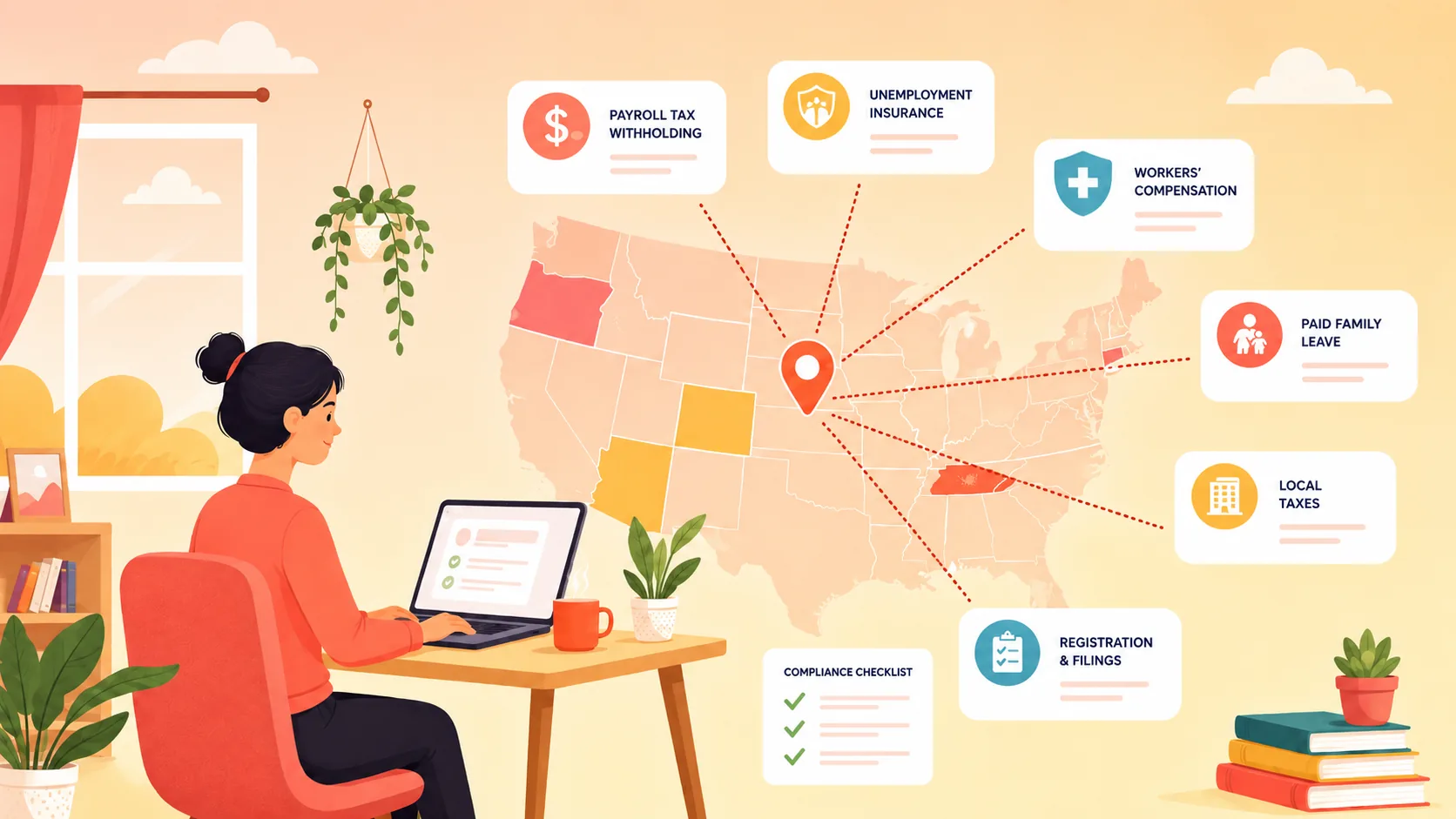
A single remote employee performing work from a new state can create taxable presence there even though your company has no office, property, or other physical operations in it. Once that happens, you're typically looking at:
- State income tax withholding registration with that state's department of revenue.
- State unemployment insurance (SUI) registration with the state's workforce agency.
- Workers' compensation coverage that satisfies that state's specific requirements, which vary in what's mandatory and at what employee count.
- Possible corporate income or franchise tax exposure for the business itself, which is a separate and more complex analysis than the payroll-side obligations - one employee can be enough to trigger a filing obligation depending on the state's specific rules.
- Foreign qualification with that state's Secretary of State in some cases, since actively doing business there (which employing someone generally counts as) may require registering as a foreign entity.
A single new-state hire can trigger five or more separate registration and filing obligations. This isn't a theoretical risk: state tax agencies cross-reference new-hire reporting data specifically to identify employers who have workers in the state but aren't registered.
The Convenience-of-the-Employer Rule
A handful of states apply a "convenience of the employer" rule that can tax income even when the work is physically performed elsewhere. Under this rule, if your employee works from home in State A but your company is based in State B, and the arrangement is for the employee's convenience rather than a business necessity, State B can continue to tax that income as though the work were performed there - creating potential double-taxation exposure that the employee (and sometimes the employer) has to untangle. This rule varies significantly by state and by the specifics of the work arrangement, and it's worth a specific check before assuming standard multi-state withholding rules apply cleanly.
Local Taxes Add a Layer Most Founders Don't Expect
State-level nexus isn't the end of it. Local jurisdictions in several states impose their own income taxes on top of state withholding - Ohio alone has over 600 taxing municipalities, Pennsylvania has roughly 2,500 local tax jurisdictions, and major cities including New York City, Philadelphia, Detroit, and St. Louis each impose their own city-level income tax that has to be withheld correctly based on exactly where the employee works.
Paid Family and Medical Leave: A Separate Registration Track
Beyond standard payroll tax and unemployment insurance, a growing list of states run mandatory paid family and medical leave (PFML) or short-term disability programs funded through employer and/or employee payroll contributions - California, New York, New Jersey, Washington, Massachusetts, Colorado, Connecticut, and Oregon are among the states with active mandatory programs as of 2026, and the list has been expanding. These require their own registration and contribution setup, separate from standard state income tax withholding, and are easy to miss because they don't show up if you're only checking withholding tables.
Classification Doesn't Change Any of This
None of the above depends on whether you call the person an employee or a contractor - it depends on the actual nature of the working relationship. If someone should legally be classified as an employee based on how the role functions, nexus and the associated obligations exist regardless of the label in the contract, and misclassification penalties (which can run into the thousands of dollars per worker in states like California) compound on top of whatever registration and withholding you should have done from day one. Our guide on employee vs. independent contractor classification covers the legal tests in more depth.
What to Actually Do Before the Offer Letter Goes Out
- Confirm the employee's actual physical work location - not their mailing address, not where your company is headquartered, but where the work is physically performed day to day. This is the fact pattern that determines nexus.
- Start state registration at least 60 days before the first payroll run in a new state. Some states process registrations in days; others take weeks, and you legally can't run payroll correctly in the interim.
- Check whether the new state applies a convenience-of-the-employer rule if your company is based somewhere else and the employee is working remotely by choice rather than necessity.
- Identify local tax jurisdictions, not just state-level ones, if the employee is in a state (Ohio, Pennsylvania, and several others) with significant municipal income tax overlays.
- Register for PFML/disability programs separately if the new state runs one - don't assume standard withholding registration covers it.
- Revisit corporate income/franchise tax exposure with your accountant, not just your payroll provider, since this is a business-level question separate from the employee's individual withholding.
The Bottom Line
An employment agreement establishes the relationship between you and your remote hire. It does nothing to satisfy the state's side of the equation - registration, withholding, unemployment insurance, workers' comp, and potentially PFML contributions and corporate tax filings, all specific to wherever that person is actually sitting when they log on. Treat every new-state remote hire as a compliance project with its own checklist, not just a contract to sign, and start that checklist before the offer is accepted, not after the first paycheck is due.
Hiring across state lines? Talking Tree offers AI-powered contract review and connects founders with experienced startup attorneys through Find Counsel. See our related guide on employee vs. independent contractor classification.