
Provisional Patent Applications for Founders: Costs, Deadlines, and the 12-Month Clock
Written and reviewed by Talking Tree's legal team
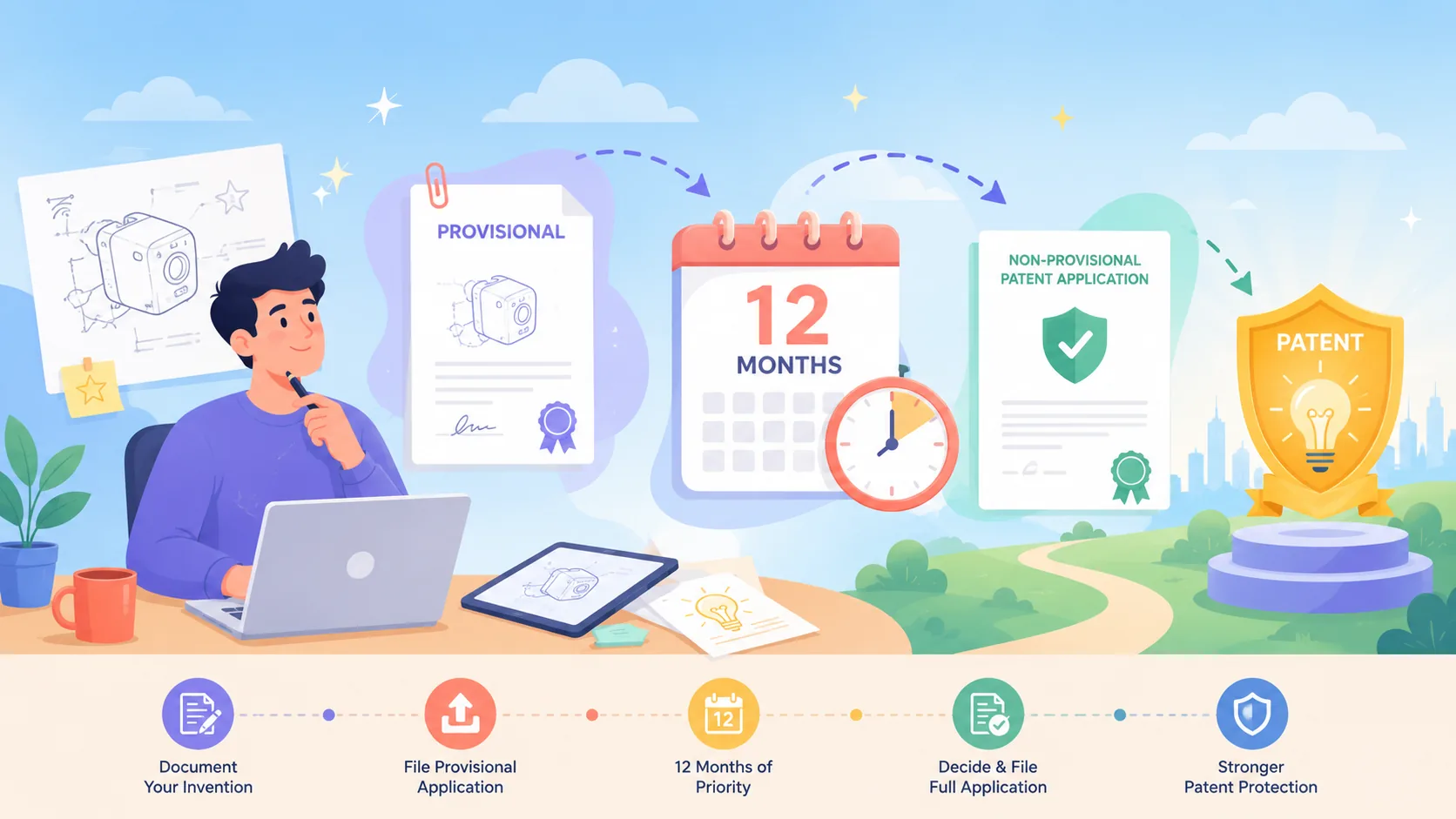
A provisional patent application doesn't get examined. It doesn't get a patent number. It doesn't, by itself, give you a patent. What it gives you is a priority date - a legal marker that you were first, which you then have exactly 12 months to convert into a real, examined patent application before it expires and the priority date is lost.
That distinction matters more than most founders realize when they file one.
What a Provisional Application Actually Costs
USPTO filing fees scale with your entity size:
- Micro entity (most individual founders and early-stage startups qualify): $65 USPTO filing fee.
- Small entity (businesses under 500 employees, most startups without outside deep-pocket ownership): $130.
- Large entity: $325.
The government fee is not where the real cost lives. A professionally drafted provisional application - meaning one with a specification detailed enough to actually support a later patent's claims - typically runs $2,000 to $5,000 all-in once attorney drafting time is included. A cheap, thin provisional filed to hit a deadline can end up costing more later: if an element of your eventual patent claim wasn't explicitly described in the provisional, that claim element cannot claim the benefit of the earlier filing date, no matter what you paid to file it.
Converting to a non-provisional utility application, which does get examined, adds significantly more: attorney fees in the $5,000-$10,000+ range on top of USPTO filing, search, and examination fees that run into the thousands depending on entity size.
The 12-Month Clock
From your provisional filing date, you have exactly 12 months to file a corresponding non-provisional (utility) application claiming benefit of that priority date. Miss the deadline and the provisional simply expires - you don't get an extension, and you lose the priority date entirely. If you still want protection, you're filing fresh, with a later priority date, which matters enormously if a competitor files anything similar in the interim.
That 12-month window is also the actual strategic value of a provisional: it buys you a year to raise money, test the market, refine the invention, or find co-inventors and get their assignments in order - all while holding your place in line at the USPTO - before committing to the much larger expense of a full utility filing.
Why "Patent Pending" Doesn't Mean What Founders Think
Filing a provisional lets you legally use the phrase "patent pending." It does not mean the USPTO has reviewed your invention, confirmed it's novel, or indicated it will eventually issue as a patent. No examiner looks at a provisional application at all. The disclosure sits in USPTO records, establishing your priority date, and nothing more happens until (and unless) you convert it.
This matters for how founders talk about it publicly and to investors: "patent pending" is a true statement about your filing status, not a signal about your patent's eventual strength or scope.
Where Software and AI Inventions Get Complicated
Patentability for software and AI-related inventions runs into a separate hurdle beyond the provisional-to-nonprovisional process: Section 101 of the Patent Act and the Alice/Mayo framework, which asks whether a claim is directed to an unpatentable abstract idea (like a mathematical algorithm or a fundamental economic practice) and, if so, whether the claim adds an "inventive concept" beyond that abstract idea using conventional computer components.
In practice, this means the specification needs to describe a specific technical improvement - to a computer's functioning, to a technical process, to how a system achieves a result - rather than simply claiming "do this common task, but with a computer" or "but with an AI model." A provisional application that only describes the outcome an AI system produces, without describing the technical mechanism that produces it, is much weaker support for surviving a 101 rejection later. This is one of the most common gaps patent examiners flag in AI-related applications, and it's much cheaper to fix at the provisional stage than after a non-provisional has already been filed and rejected.
What to Get Right Before Filing
- Disclose every element you might eventually claim. If it isn't in the provisional, it doesn't get that filing date - draft as if you're writing the real application, because for priority-date purposes, you effectively are.
- Identify all co-inventors before filing, not after. Inventorship is a legal determination based on who contributed to the claimed invention, not who's on the cap table - get inventor assignment agreements in place early so ownership isn't a loose end during diligence later.
- Confirm your entity status (micro, small, large) before paying fees. Claiming a discount you don't qualify for can create problems for the patent's validity down the line.
- Calendar the 12-month deadline the day you file, not the week before it's due - converting a provisional into a non-provisional takes real drafting time, and starting that process at month 11 leaves little room for a mistake.
- For software or AI inventions, describe the technical mechanism, not just the result - this is the single biggest difference between a provisional that supports a durable patent and one that doesn't survive a 101 challenge later.
The Bottom Line
A provisional application is not a lightweight substitute for a real patent - it's a deliberate, time-boxed bet that buys you 12 months to decide whether the invention is worth the much larger investment of a full utility filing. The government fee is trivial. The disclosure quality and the calendar discipline around the 12-month deadline are where provisional filings actually succeed or fail.
Filing a provisional patent or protecting other IP? Talking Tree connects founders with experienced startup and IP attorneys through Find Counsel. See our related guide on trademark protection for startups.