
How to Protect Your Company When Non-Competes Are Not Enforceable
Written and reviewed by Talking Tree's legal team
For about four months in 2024, it looked like non-compete agreements were headed for extinction nationwide. The FTC finalized a rule banning nearly all of them. Founders who'd been quietly enforcing employee non-competes for years started asking whether they even needed to bother anymore.
Then a federal court in Texas blocked the rule before it took effect. The FTC appealed. Under new leadership, the agency then withdrew the appeal entirely, and in February 2026 formally removed the rule from the Code of Federal Regulations. There is no federal non-compete ban. The rule never actually took effect. The episode changed nothing about what you can legally put in an employment agreement.
What has changed is the state-by-state picture underneath it - and that's what founders actually need to track, because non-compete enforceability by state varies enormously and it's still moving.
Non-Compete Laws by State: What's Enforceable in 2026
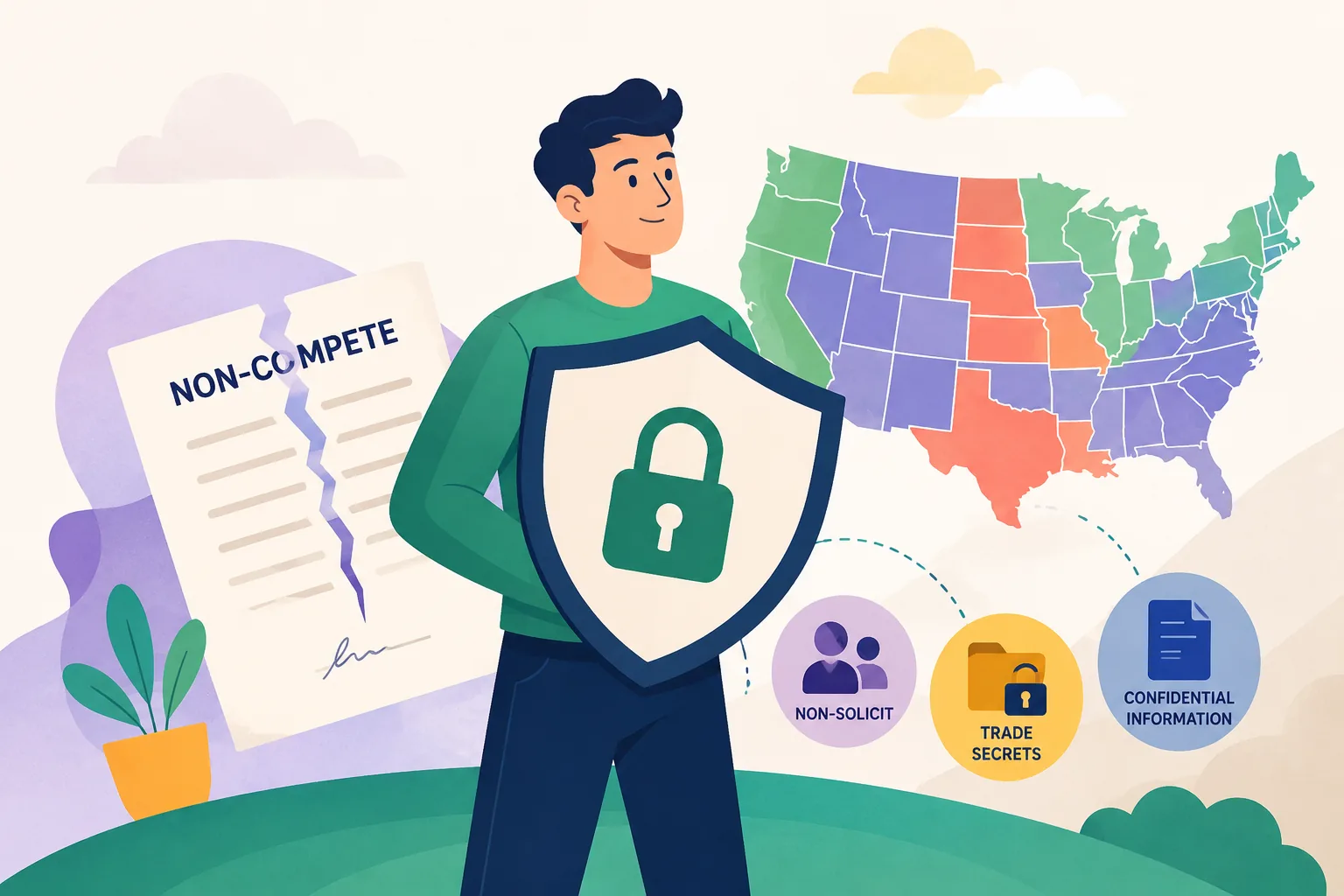
Non-compete enforceability in the U.S. isn't one rule - it's roughly fifty different ones, ranging from unenforceable to freely enforceable:
- California - Non-competes are void under Business and Professions Code Section 16600, with almost no exceptions. 2024 amendments added real teeth: employers can face civil penalties for even presenting a non-compete, regardless of whether they try to enforce it. If you have any California employees or contractors, a non-compete clause is a liability, not a protection.
- Texas - Enforceable if reasonable under Business & Commerce Code § 15.50. Must be ancillary to an otherwise enforceable agreement, with reasonable limits on time, geography, and scope.
- Florida - Enforceable if reasonable under Statute § 542.335, and one of the most employer-friendly states in the country: courts are barred from weighing harm to the employee in the enforceability analysis.
- Delaware - Enforceable if reasonable under common law, but Delaware Chancery Court has grown more willing to strike down (not just narrow) overbroad restrictive covenants in LLC and equity agreements in recent cases.
- New York - Currently enforceable under ordinary common-law reasonableness review, with no statutory ban in effect. This is the least stable state on the list: the legislature passed a near-total ban in 2023 that Governor Hochul vetoed for lacking a salary carve-out. A revised bill - banning non-competes below roughly $500,000 in annual compensation - has now passed the Senate twice and is pending in the Assembly.
- Colorado, Illinois, Massachusetts, Oregon, Virginia, Washington D.C., New Hampshire, and others - Non-competes are enforceable only above an income threshold that typically adjusts annually for inflation. Below the threshold, the agreement is void regardless of what it says.
- New Mexico - Voided non-competes for healthcare workers under a 2025 statute.
- Iowa - Barred non-competes for University of Iowa Health Care physicians, PAs, and nurses via 2026 legislation.
The trend line across nearly all of this activity points one direction: more restriction, not less, even in employer-friendly states, and it's moving faster in some sectors (healthcare especially) than others. If your non-compete strategy assumes "most states allow this if it's reasonable," that assumption is eroding state by state.
Why a Template Non-Compete Fails a Multi-State Team
A standard employment agreement template can include non-compete language. What it can't do is tell you whether that language is worth anything in the state where your specific employee actually works - which, for a remote-first company, may be a different state than the one your entity is incorporated in, and may change if the employee relocates.
This creates a specific trap: a non-compete applied uniformly across a distributed team is, at best, enforceable against some fraction of that team and dead weight against the rest. At worst, in a state like California, it's an affirmative liability regardless of whether you ever try to enforce it.
The real question isn't "should we have a non-compete." It's "what are we actually trying to protect, and is a non-compete the right legal tool for that in the states where our people live." For most startups, the underlying goal - stopping a departing employee from taking your customer list or product roadmap straight to a competitor - is better served by tools that hold up even in restrictive states.
How to Protect Company IP Without a Non-Compete
- Customer and employee non-solicitation agreements. Courts in states that gut non-competes are often far more willing to enforce a narrowly drawn non-solicit, because it restricts specific conduct (poaching customers or coworkers) rather than the person's ability to work at all - the exact distinction driving the state-law trend.
- Trade secret protection under the Defend Trade Secrets Act and state equivalents. This is a standalone legal claim, not a contract term - it's available against anyone who misappropriates genuinely secret, competitively valuable information, and it travels with the information regardless of what state the person moves to. It does require you to have actually treated the information as secret: access controls, need-to-know restrictions, and confidentiality agreements with anyone who sees it.
- Confidentiality agreements (NDAs). These restrict disclosure and use of specific confidential information without restricting where someone can work next, which is why they're enforceable almost everywhere, including California. See our guide on when NDAs actually work for what a well-drafted one should cover.
- Garden leave. Rare below the executive level, but for senior roles, paying someone to sit out a transition period - rather than restraining them for free - sidesteps most non-compete hostility because it's compensated and time-bound.
- Narrow invention assignment provisions. Separate from non-compete enforceability entirely - this governs who owns what an employee built while working for you, and it's enforceable everywhere. Our founder agreement guide covers how this should be structured from day one.
For most early-stage companies, a solid NDA, a customer/employee non-solicit, and genuine trade-secret hygiene get you most of the protection a non-compete would have offered, with none of the state-by-state exposure.
What to Do With Your Existing Non-Competes
If you're in California: Remove non-compete language from your templates now. Presenting one - even one you never intend to enforce - carries civil exposure under the 2024 amendments. Audit existing agreements with California-based employees and contractors and strike the clause.
If you're hiring across multiple states: Build your restrictive-covenant strategy around the least permissive state you operate in, not the most permissive. A patchwork of state-specific non-compete language is a maintenance burden most startups aren't equipped to keep current - lean on non-solicits and confidentiality agreements as your baseline, and treat a non-compete as a bonus where it's clearly enforceable, not the backbone of your protection. This is closely related to the classification questions in our employee vs. independent contractor guide - misclassifying someone compounds any restrictive-covenant problem you already have.
If you're in New York: Don't restructure around the pending bill yet - it hasn't cleared the Assembly, and Hochul has vetoed a prior version. But don't build anything long-term on today's permissive rule either. Watch it.
Everywhere: Keep any non-compete language narrowly tailored - reasonable in duration (courts are increasingly skeptical of anything beyond 12-24 months), reasonable in geographic scope, and tied to an actual protectable interest, not just "don't work for a competitor." Overbroad language is exactly what gives courts in reasonableness-review states an excuse to void the whole clause rather than narrow it.
The Bottom Line
The FTC's attempt at a nationwide non-compete ban is completely dead - not paused, not on appeal, formally removed from the federal register. But that was never really the part that mattered for most startups, since it never took effect in the first place.
What matters is the state-by-state patchwork, and it's getting more restrictive almost everywhere, unevenly and unpredictably. The more durable approach isn't fighting to keep a non-compete enforceable in a hostile jurisdiction - it's building protection around tools that hold up regardless of which state your next hire happens to live in.
Building or auditing your employment agreements? Talking Tree offers AI-powered contract review and connects founders with experienced startup attorneys through Find Counsel. For related reading, see our guides on co-founder equity splits and negotiating your funding round.