
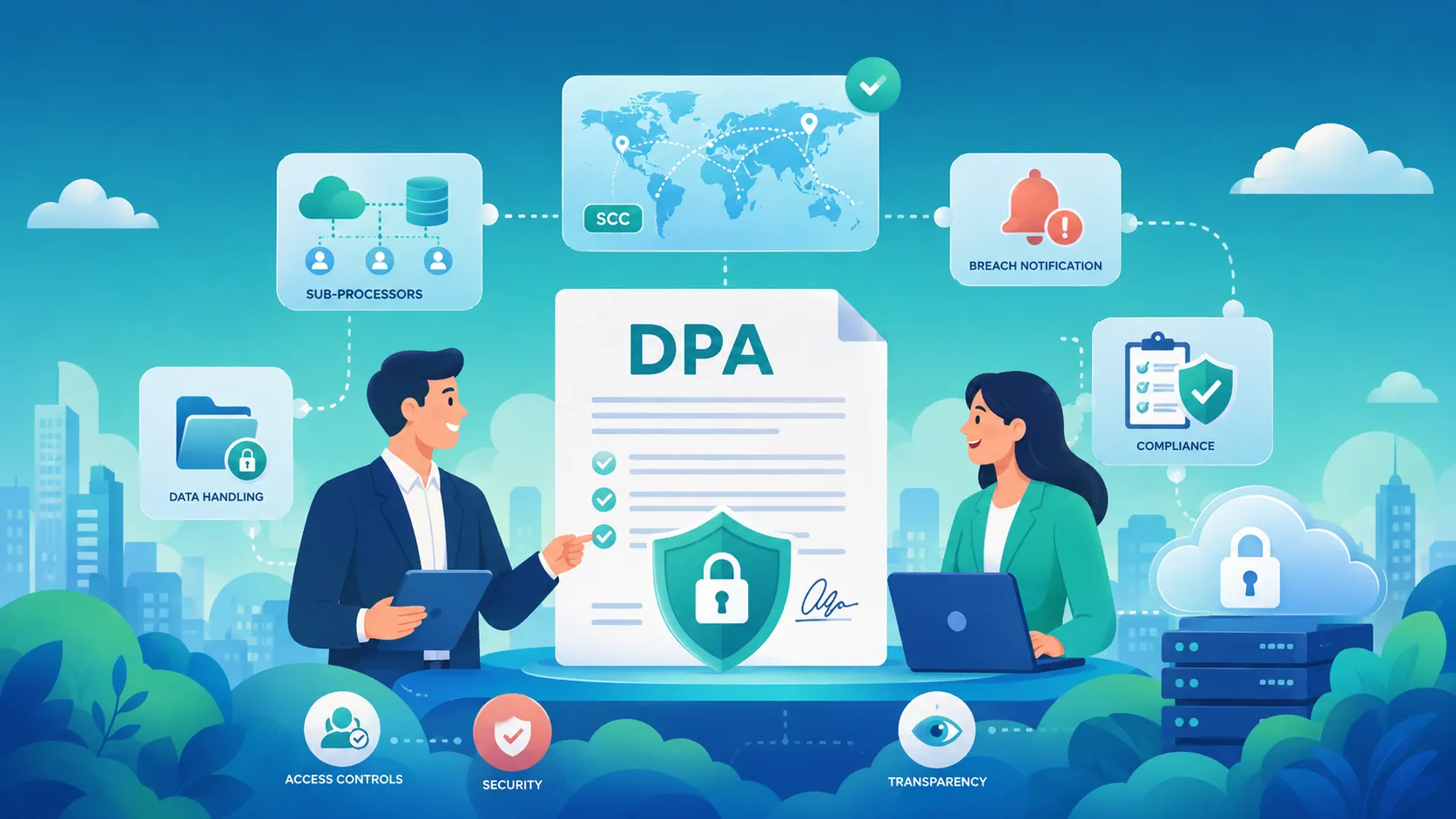
Data Processing Agreements (DPAs) in Enterprise SaaS Deals: What Buyers Actually Require
Written and reviewed by Talking Tree's legal team
A well-drafted MSA covers the commercial relationship: scope, price, term, liability. It does not, on its own, satisfy what an enterprise buyer's privacy or security team needs to see before they'll sign off on your SaaS product - which is a separate Data Processing Agreement governing exactly how you handle their (and their customers') personal data.
For startups selling into enterprise accounts for the first time, the DPA request often arrives as a surprise late in the sales cycle. It shouldn't be.
Why a Standard MSA Isn't Enough
An MSA typically addresses the business terms of the relationship. A DPA addresses a narrower, more specific question required by data protection law itself: as the entity processing personal data on the customer's behalf, what obligations do you have around that data's security, use, and onward transfer, and what happens if something goes wrong?
Under GDPR specifically, Article 28 requires that any processing of personal data on a controller's behalf be governed by a written contract containing specific mandatory terms - not just "reasonable data handling," but enumerated requirements around processing scope, sub-processor authorization, data subject rights assistance, breach notification, and deletion or return of data at contract end. An MSA that doesn't explicitly cover these isn't just commercially incomplete - it doesn't satisfy the legal requirement, which is precisely why enterprise buyers insist on a standalone DPA rather than folding these terms into the general agreement.
Standard Contractual Clauses: Still the Load-Bearing Mechanism in 2026
If your company processes personal data that originates in the EU and stores or processes it in the US, you need a lawful transfer mechanism. Most enterprise DPAs in 2026 build this in one of two ways:
- Reliance on the EU-US Data Privacy Framework (DPF), if your company has self-certified under it - this avoids the need for a separate transfer mechanism for the specific transfers it covers.
- Standard Contractual Clauses (SCCs), the European Commission's approved contractual terms (the 2021 version, replacing older templates), paired with a Transfer Impact Assessment (TIA) - a documented evaluation of whether the destination country's law and practice allow the data importer to actually comply with the SCCs' protections.
Even companies self-certified under the DPF are increasingly asked to keep SCCs and a TIA in place as a fallback, rather than relying on DPF certification alone. This isn't excess caution: the DPF survived its first legal challenge in September 2025, but in July 2026 the European Data Protection Board formally asked the European Commission to reassess the framework's adequacy following a US court decision affecting the FTC's structural independence - one of the safeguards the original adequacy finding relied on. Nothing has been invalidated as of this writing, but enterprise privacy teams have gotten more conservative about single-mechanism reliance, and a startup that can offer SCCs alongside DPF certification looks more diligence-ready than one that can't.
What Enterprise Security Questionnaires Actually Ask
Alongside the DPA itself, expect a security questionnaire covering:
- Sub-processor disclosure and approval rights - which vendors (cloud hosting, analytics, support tooling) touch the customer's data, and whether the customer must be notified or can object before you add a new one.
- Breach notification timelines - enterprise buyers commonly push for notification within 24-72 hours of discovering an incident, tighter than some statutory minimums, and this is a heavily negotiated term.
- Data residency and retention - where data is stored, how long it's retained after contract termination, and confirmation of deletion or return at the relationship's end.
- Security certifications - SOC 2 Type II is the most commonly requested baseline for B2B SaaS vendors; some enterprise buyers in regulated industries will ask for ISO 27001 as well.
- Audit rights - whether and how the customer (or a third-party auditor on their behalf) can verify your security practices.
Negotiating Liability Caps for Data Incidents
This is usually the most contested section of the DPA, and it's worth understanding the standard structure before a buyer's redline arrives:
- General MSA liability caps (often tied to fees paid over 12 months) are standard for ordinary breach-of-contract claims.
- Data breach and confidentiality liability is frequently carved out from the general cap, either uncapped or capped at a much higher multiple (sometimes 2-5x annual fees, sometimes tied to a fixed dollar amount).
- A lean startup's negotiating position is to push for the carve-out cap to be a defined multiple rather than uncapped, and to tie your indemnification obligations specifically to breaches caused by your own security failures - not to security incidents at the customer's own environment or caused by their misuse of the product.
- Cyber liability insurance matters directly here: enterprise buyers increasingly ask for proof of coverage at a specific minimum, and the coverage amount you can actually obtain is a practical ceiling on what liability cap you can responsibly agree to.
What to Have Ready Before the DPA Request Arrives
- A standard DPA template that already includes SCCs as an exhibit, not something drafted fresh for each deal.
- A current sub-processor list, ready to disclose without a scramble.
- SOC 2 Type II (or equivalent) certification, or a credible timeline if you're still working toward it.
- A defined breach notification process with an internal owner and a realistic timeline commitment.
- A liability cap position worked out with counsel and, ideally, cyber insurance coverage in place before you're negotiating the number under deal pressure.
The Bottom Line
The MSA gets the commercial deal done. The DPA is where an enterprise buyer's privacy and security requirements actually live, and showing up to that negotiation with a template already built - SCCs attached, sub-processors disclosed, certifications in hand - turns what's often the slowest part of an enterprise sales cycle into a much faster one.
Negotiating an enterprise DPA or building your privacy program? Talking Tree offers AI-powered contract review and connects founders with experienced privacy and technology attorneys through Find Counsel. Start with our data processing addendum template and our guide on negotiating your first customer contract.